
The 8020 Drummer

Practice Smarter
  • Free Lessons
  • Coach Yourself
  • 1:1 Coaching From Me
  • Group Coaching
  • Free Lessons
  • Coach Yourself
  • 1:1 Coaching From Me
  • Group Coaching

Blog

I Was Wrong About E Drums

Nate Smith January 1, 2026

First things first - grab your free transcription here.

If you know me you know - I have historically not been a fan of E-drums.

And historically, E-drums haven’t been very good.

Sorry.

“Twacky” rubber, or mesh heads with unrealistic tactile responses.

“Gated” sounds that omit all the '“analog” gradations and “messiness” of acoustics.

And their general…unsightly…appearance.

And over the years, various E-drum companies have offered to send me drums to review, but I’ve always refused.

But this year, it just so happened that when one such manufacturer DMd me, I was in a bit of a “YOLO” state of mind. I needed a gear review for the content calendar anyway, so I said “yes” - on one big condition: there was zero guarantee of a positive review, and I wouldn’t propagandize for them. If they sent the drums, they would get a candid review - upsides, downsides, and all.

The company - Roland - agreed.

What followed was a comedy of errors: the sheer enormity of the shipment, which barely fit in my mail room, and required an environmental’s nightmare worth of boxes. My comic ineptitude with making sure I had all the cables, connecting them properly, then connecting everything to my digital audio workstation, so I could bring you the sound.

I really wanted to hate them. But I failed.

The truth is…E-drums have changed. These aren’t your great uncle’s E-drums. The response is way better, both tactilely and in terms of mimicking the sound response of “real” drums. The appearance is way more similar to a mid-tier acoustic “wrap” kit than their predecessors. This is a kit that actually looks good in the den or rumpus room. And the one item Roland requested I feature - the recorded sound - is really good, especially if you don’t have pro mics and a lot of experience mixing and mastering your acoustics.

Still, they’re not perfect, and they’re not for everybody.

For my complete review, including misadventures, pros, cons, and a cheeky flow warmup (the transcription), peep the video!

Hope you enjoy!
7 Comments

This Is Killing Your Progress on Drums

Nate Smith December 17, 2025

First things first - grab your free transcription here.

This week sees a return to an old hobby horse. Practically what put 8020 “on the map”.

Years ago, while developing one of my courses, I took a survey. I was interested in the mistmatch between drummers’ stated goals, and their practice routines. I had expected something like poor time-management, and/or a few adjustments at the margins. What I found, of course, was a complete-and-total mismatch.

Complaint: “I don’t know why what I practice isn’t coming out in my playing!”

Goal: Play clean, musical fills and beats, be able to get around the kit.

Practice routine: the literal same exercises out of drum books that they’d been doing for decades. Hand warmups, abstract “independence exercises”.

Addendum: Plus a decent dollop of “literal transcription of whatever I saw on Instagram this week”.

Since then, course materials have evolved somewhat. I and others are producing materials that more resemble real-world playing.

Many of these “contemporary” materials even emphasize the “missing piece”, which we’ll get to. It’s just that many players are explicitly skipping that part.

So - what’s missing?

Let’s look at language learning. Say you memorize a bunch of literal sentences. Then you go to a bar and try to hang out with native speakers.

No one would be surprised what they practiced “wasn’t coming out in their conversation” if they hadn’t practiced making their own sentences and free-associating with the vocab they’d learned.

Heck - let’s even take this to a different instrument. Let’s say you practiced a bunch of scales, and even some simple Charlie Parker transcriptions on the horn. Then it came time to solo on a different tune. Nobody would be mystified that they couldn’t solo over Dolphin Dance if all they’d practiced was CP’s solo on one chorus of Confirmation.

But somehow we don’t notice the “missing piece” on drums: practicing improvisation.

And not just unstructured improvisation; improvisation with relevant vocabulary, with guard-rails and increasing degrees of freedom. Improvisation that begins with kernels of exactly what you eventually want to play, then steps you closer to…well - fully improvising…with that stuff.

So why?

I have a couple of pet theories.

One is that drums are less “solo-based”, in that, especially if you don’t play jazz, you can go an entire lifetime just playing the repetitive loops we call “beats”.

Another is that “written out” stuff is easier to teach - a teach has only to improvise in front of a camera or microphone, then hand the recording off to somebody to transcribe, then that goes in the book.

And the third is probably that we like written out stuff more too. It’s less cognitively demanding. More like reading a book and less like writing one.

But around once every few years I have to draw a line in the sand and say “this is what’s killing drummers’ progress”. The culture of courses has evolved from abstract hand exercises to relevant vocabulary, and even improvisation practice with the ideas.

I’m trying, in a small way, to evolve the norms around actually doing that part.

Hope you enjoy!

1 Comment

3 "Pro" Drum Beats Most Drummers (Probably) Can't Play

Nate Smith December 10, 2025

First things first - grab your free transcription here.

I’m endlessly fascinated by drum stuff that looks easy, but is hard. In lessons/videos/etc, sometimes I need to work to make the case that there’s “another layer” of subtlety. Indeed, my first few weeks working with many drummers are spent simply discovering that that layer exists.

We can tell on the surface that there’s something Tony Williams has that we don’t, for instance. But try to go into the practice room and practice a detail that will get you closer to Tony. The picture gets pretty “pixelated” when you zoom in far enough. You can lose the forest for the trees.

That’s why I love “heuristic beats”. Beats you simply won’t be able to make sound good unless these “second layer” subtleties are in place.

No disrespect to the great drumming on either of them, but songs like ACDC’s Back in Black or Tom Petty’s You Don’t Know How it Feels are songs I’d give to a more beginner student, because either the bass line buoys you along and provides “guide posts”, or stays out of the way, allowing you to simply place your beat in approximately the right spot, and it’s going to sound great.

If you try that with Aaron Parks’ Karma, which Eric Harland made famous, it will simply sag if you don’t have high level subdivision, coordination, and dynamics.

Try it with Nate Smith’s Skip Step, and it will lose tension and momentum if your lead hand technique and beat placement aren’t near-perfect.

Try it with Corey Fonville’s drum part on Christian Scott’s Twin, and unless you can layer your 8th notes 1:1 on top of the invisible matrix the bass and piano are creating, it will not only not “snap”, but create a hot mess.

So, for fun, I decided to feature those beats in today’s video. We’ll listen to the “pro” play them, we’ll dissect what makes them hard, then we’ll take you through, step-by-step, how I’d recommend playing them.

This one was transcription-heavy, so special thanks to Chris for his help with the transcription.

Hope you enjoy!

1 Comment

Are Drummers Today Too Obsessed With Speed?

Nate Smith December 3, 2025

First things first - grab your free transcription here.

It’s hard to say exactly what made this “click”.

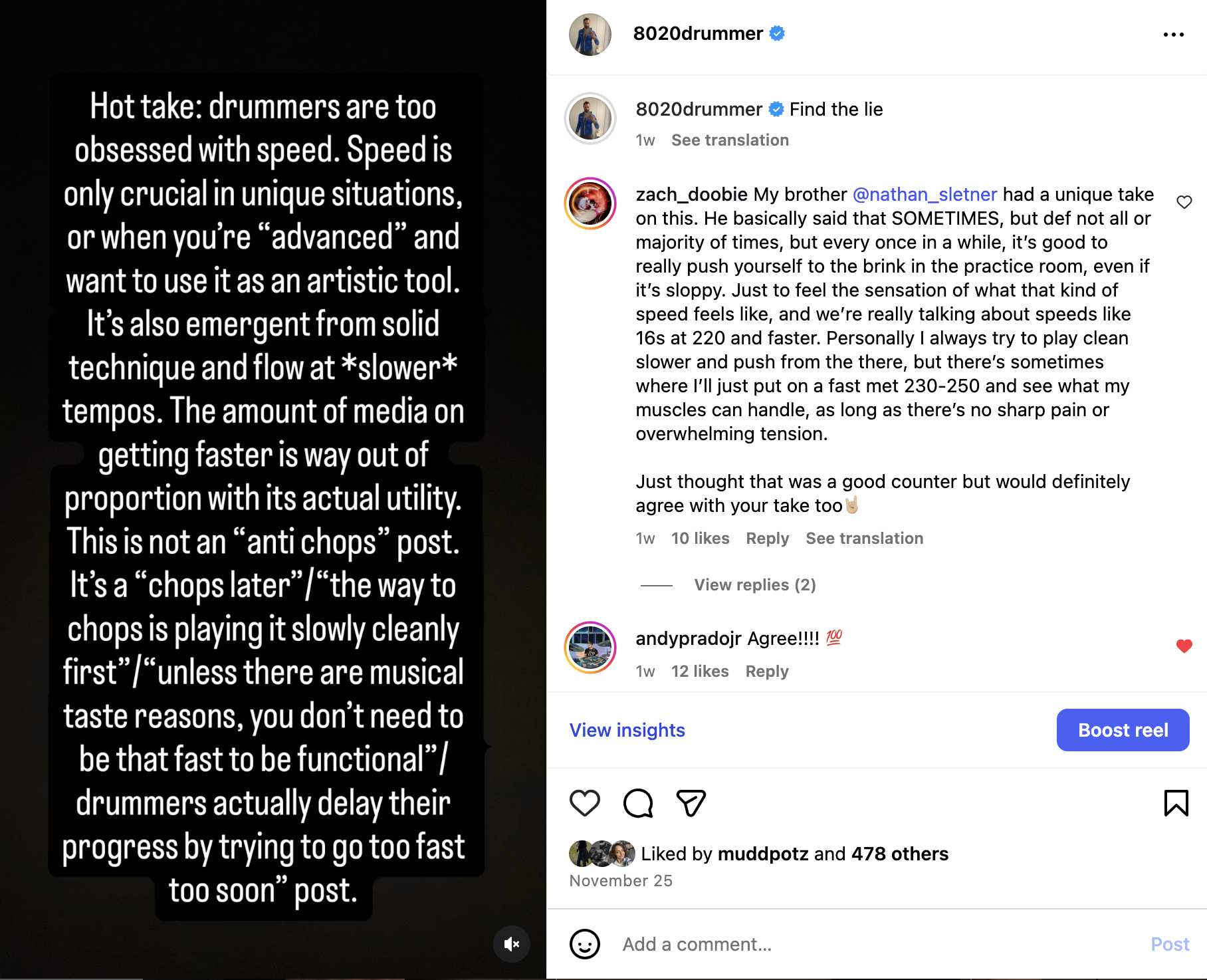
Maybe it was answering questions from commenters about “how fast should I go with xyz”.

Maybe it was my growing collection of thumbnails emphasizing specific percentage gains in speed in specific amounts of time.

But last week, the dam broke, and I made a social media post about it.

Speed is a tool for musicality.

It’s also a by-product of work on flow, idea generation, technique, etc.

But it’s become something more. It’s become the guaranteed “ring in case you need video views” tool.

And lest you think I’m calling anyone else out, I’ll own that I myself have happily availed myself of this lever. I’ll probably do it again.

But for just one video, I decided to weigh in on the contrary. To “counter balance” things.

I believe the prevalence of “get more speed” in drum instruction is out -of-pace with its utility.

If you want Andy-Prado-like chops, a large amount of that work is done slowly. (Though, yes, you eventually have to practice fast to see what “lies well” on the kit.)

And if you don’t, rest easy: the vast majority of practical drumming doesn’t require it.

But not so easy - you still have to put in the work on timing, cleanliness, and idea flow. (Doh!)

In any case, please enjoy my treatise on the state of speed in 2025.

As usual, leave a polite comment below.

Comment
  • Blog
  • Older
  • Newer

Welcome to The Blog!

Here you can check out an archive of lightly-guarded exclusive content for mailing list subscribers, including early access to podcast episodes and youtube videos.

youtube facebook
  • Quick Taste
  • About Me
  • Podcast


The 8020 Drummer

Practice Smarter

Stop practicing stuff that doesn't work. The 80/20 Drummer is dedicated to cutting through the BS, so you practice Only the important things. Save time, and start getting better.

youtube facebook